
This newsletter is for your information only and is not a substitute for talking with your psychiatrist, medical doctor, and/or therapist.
Download a PDF version of this issue (135k)

The core feature, which must be present for the diagnosis of Tourette's, is the presence for at least a year of at least two motor and one vocal tic, not necessarily at the same time. The diagnosis, and any treatment, is only appropriate if the tics cause social, emotional, and/or physical problems. Tourette's occurs in up to 1% of the population, is 3 to 4 times more common in boys, almost always begins before the age of 18 and usually begins in elementary school age children. Transient or Chronic tic disorders are more common (up to 15% of people at some time in their lives) and do not meet the criteria for the more significant Tourette's disorder. The cause of Tourette's is clearly a biological one in certain parts of the brain, particularly connections involving the basal ganglia, and is usually inherited. Tourette's may be very mild, very severe, or anywhere in between.
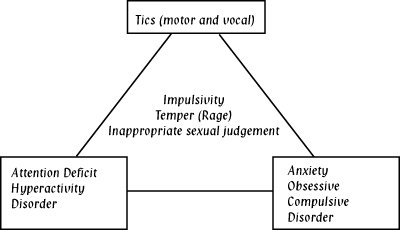
It is often easiest to think about Tourette's Syndrome diagramed as an equilateral triangle where tics are on the top (required for the diagnosis), Attention Deficit Hyperactivity Disorder at the front or leading corner (ADHD often presents first or along with the tics), and anxiety or Obsessive Compulsive Disorder at the back corner (anxiety and/or OCD often present after or along with the tics). Inside the triangle, as part of or associated with Tourette's, but not diagnostic of Tourette's, are the too often pronounced problems with impulsivity, temper, and/or inappropriate sexual or seemingly sexual behavior. Persons with Tourette's may have unusual preoccupations, learning disorders, and/or the full range of symptoms seen in ADHD or OCD. The life course of the tics is that they frequently begin in elementary school or even earlier, increase to a peak in frequency and intensity around puberty, and then decrease again and become easier to control as the youth moves through adolescence and into adulthood.
Tics are best described as quick, twitching semi-involuntary, repetitive movements of individual muscle groups. Tics typically occur in "bouts" where one or several types of tics will occur repeatedly over minutes to hours, days, or weeks. Tics are sometimes preceded by an uncomfortable feeling in a body area that the movement or sound makes "just right". Tics can be simple or complex and affect motor or vocal areas. Motor tics are observable muscle movements. Vocal tics are sounds emitted when small muscle groups twitch in the area of the nose, mouth, and/or throat thereby producing a sound. Simple tics are the movements of small muscles or groups usually in the face, throat, head, neck or shoulders and are typically not seen as having a purpose. Examples of simple motor tics are eye blinking, squinting, forehead furrowing, nose wrinkling, lip pursing, gaping, grimacing, head nods or shakes, arm jerking, kicking without purpose, jaw twitches, teeth clicking, muscle tensing, and shoulder shrugs. Examples of simple vocal tics may be sniffs, coughs, throat clearing, spitting, screeching, barking, grunting, brief whistles, hissing, and monosyllabic non word sounds. You can see how some of these can be confused with allergy or other health symptoms. Complex tics are bigger more purposeful seeming movements or sounds that often involve more muscle groups or combining sounds. Examples of complex tics may include gyrating, twisting, hopping, uttering or repeating words, touching, throwing, biting oneself, picking scabs, biting fingernails, repeating short phrases like, "oh boy", "all right", " you're fat", etc. Coprolalia is the use of obscene or other socially inappropriate words or phrases in a complex tic. Persons with the coprolalia of Tourette's generally try to avoid such expressions or bury them in hidden ways. It is important to remember that most nail biting, name calling, and cussing have nothing to do with Tourette's. In fact, I do not count possible complex tics toward the diagnosis of Tourette's unless I am convinced of the presence of simple tics, as well.
Tics are semi involuntary. This is confusing to many parents before they understand Tourette's. When told to stop that irritating repetitive grimace, squint, sniff, cough, etc their child can do so, for a while, minutes, even hours. But it comes back. Parents may note the child has more tics when stressed or when nervous or anxious or excited. Frequently the child suppresses the tic at the doctor's office or at school, seeming to release it with a vengeance later or at home. The type or muscle group affected by a tic often changes with time.
Recent studies have shown that at least a few cases of Tourette's and OCD are caused or worsened indirectly by certain strep infections. These are known as PANDAS. An infection by beta hemolytic group A streptococcus (most commonly "strep throat") causes the body to develop an antibody auto immune response to attack the strep bacteria. A few weeks later, these antibodies may attack certain cells in the body they confuse with strep, thereby causing illness. This occurs in Scarlet Fever, Rheumatic Fever, post-streptococcal Glomerulonephritis, and Sydeham's Chorea depending on whether the skin, heart, kidney, or brain are affected, respectively. When certain areas of the brain are affected tics and/or obsessions and compulsions can result, usually temporarily. Certain severely or repetitively affected individuals may benefit from continually taking penicillin for prevention or using certain other more involved means to decrease the problematic antibodies.
Treatment for Tourette's requires first considering whether the tics or associated problems are currently causing enough distress to warrant treatment. Then, one must consider what is the target symptom(s) and how might treating that symptom (eg, tics or attention or impulsivity or compulsions, etc.) affect others. For example, if we treat attention deficit symptoms with the usual stimulant medicines we may worsen tics while not helping obsessions at all. Treatment may require multiple interventions as described in the Four Point Treatment Plan I laid out in my ADHD information packet. The most commonly used first line medicines to treat tics are Tenex (guanfacine) or clonidine, with guanfacine having better duration, less sedation, and equal benefit for impulsivity and attention. The Catapres skin patch provides clonidine without a pill and often works quite well but often irritates the skin excessively. The more powerful anti tic medicines are all relatives of the antipsychotics, though they are not for that in Tourette's. Orap (pimozide) has been shown in a good recent study to be better than the prior first choice Haldol (haloperidol) with Risperdal (Risperidone) and other "atypicals" being good options. Each of these are very good for tics, impulsivity, and rage but do little for ADHD or OCD. The "antipsychotics" are usually monitored for reversible parkinson's like side effects and possibly irreversible Tardive Dyskinesia, if they are kept for years. Pimozide may be monitored for the unlikely advent of heart rhythm effects. When problematic tics, ADHD, and OCD occur together in more severe Tourette's a combination of medicines and other treatments, as in my four point plan, is often best. This can generally be done quite safely and with good benefit.
It is not unusual to have OCD occur along with tics in Tourette's Syndrome. The brain pathways and genetic mechanisms that produce tics seem to overlap substantially with those that lead to ADHD and OCD. It can at times be difficult to sort out certain tics from an obsession or compulsion. Please refer to my article on OCD and also refer to my information packet on ADHD on my web site. There are also excellent internet links to the local and national Tourette's Association from my web site in the Mental Health Links section.
Trichotillomania (TTM) is repetitive or compulsive hair pulling. Most commonly, TTM is the excessive pulling out of eye lashes, eye brows and/or hair on the head (scalp). However, the hair pulling may affect other or even all areas of the body. TTM is not diagnosed unless the hair pulling is severe enough to cause emotional or social problems. TTM, like most disorders, may be mild to severe and anywhere in between. A person may have TTM at one point in their life or at many points or even constantly to varying degrees for life. TTM usually affects appearance to only a limited degree for weeks to months and typically the hairs grow back without any lasting damage. In more severe and chronic cases where many hair roots are pulled out, the bald spot may become permanent. Plastic surgery may even be advised.
TTM is most often seen in adolescent girls and young women but may appear at any age and in males. TTM may appear alone but is often associated with an anxiety disorder and/or some depression. The anxiety, such as obsessive compulsive (OCD) features, usually seems directly related to the cause of TTM while the depression seems more often related to the distress of having TTM. More recently, the overlap between obsessive thoughts, compulsive actions, and tics (such as in Tourette's syndrome) has caused clinicians to rethink the overlap between these symptoms and the hair pulling of TTM. TTM both tends to run in families and seems caused by abnormalities in the basal ganglia areas deep in the brain which also play a key role in Tourette's and OCD.
Many cases of minor to moderate TTM in youth will pass with development and time, with or without treatment. Societal forces focusing excessively on the lashes, brows, and hair of teenage girls don't help. Dermatologists see people with TTM, just as they often see patients with so called "neurotic excoriations" or psychogenic dermatitis or neurodermatitis. These patients scratch or pick their skin excessively. Although treatment often helps, the best treatments for TTM are not proven yet. Typically the person with TTM is greatly troubled by the urge to pull or pick but may try to deny it. The urge is often increased by stress. Unfortunately, only a few minutes of giving in to the urge to pull or pick leads to weeks of an obvious bald spot. The youth's guilt and frustration with her lack of control and the parent's upset or the negative social effects can lead to substantial family turmoil as each feels powerless and frustrated at this too often misunderstood disorder.
Treatment may involve behavior management techniques aimed at distracting or redirecting the urge and behavior. Learning alternate stress management as well as education helps those affected to cope better. There are also support groups and a national organization dedicated to helping and educating. Medication treatment follows from the newer understanding of the brain circuitry involved. Frequently, an SRI (see above)) is a first choice and other medications with dual action (Effexor XR), or a booster or tic medicine such as Pimozide (Orap), Risperdal, or Geodon may be useful. As in other psychiatric disorders, a combination of psychotherapy and medication is often best, especially for the moderate to severe or chronic and recurrent cases.